
Saouaf – onshore Northern Tunisia
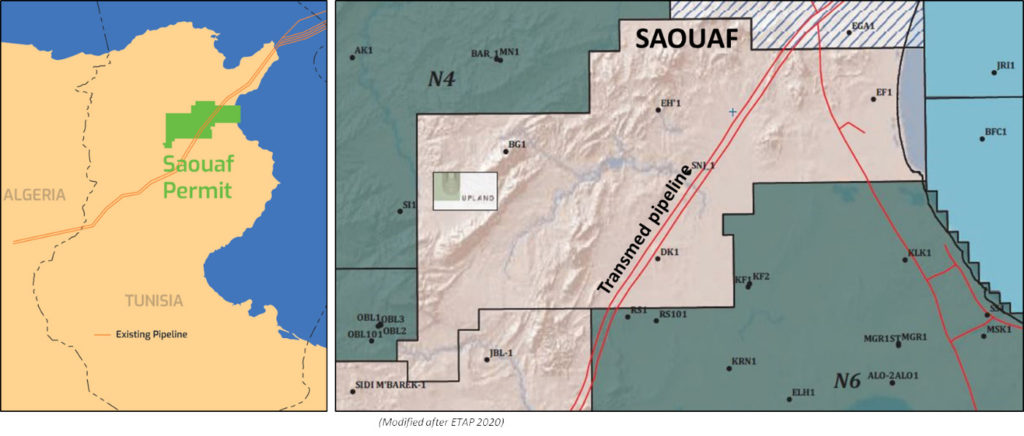
Upland (Saouaf) Limited, the fully owned subsidiary of Upland Resources Limited, acts as operator with ETAP as its partner in a 50:50 joint venture on the Saouaf license (onshore Tunisia) since the 24th of December 2019.
The large Saouaf licence covers an area of 4,004 km2, and it is currently in its first (prospecting) validity period, lasting until the 23rd of December 2022.
Upland’s work obligations in the prospecting phase of the license are to carry out geological and geophysical studies, to reprocess existing 2D seismic data and to acquire, process and interpret 300 km of new 2D seismic data. At the end of the validity period Upland has the option of entering the exploration phase of the license, which calls for acquiring additional 150 km of 2D seismic lines and drilling the first exploration well.
The Saouaf licence area includes pipelines such as the large diameter Transmed pipeline, with gas compression stations and significant spare capacity. This provides reliable access to the local gas market and commercialisation.
Since the award of the license, Upland has made meaningful progress in the Saouaf area, appointing a highly experienced external consultant (GA.I.A. srl) to undertake detailed geological and geophysical studies of the license area in order to mature a comprehensive lead and prospect inventory and assess the most efficient way for de-risking them, while increasing the Chance of Success.
A first pass multidisciplinary geological and geophysical interpretation was completed, and included an original 1D basin modelling study which was made to assess the degree of maturity of the known and hypothesized source rocks within and around the license area.
Proven play concepts have been analyzed and evaluated, and new plays discovered. Only residual potential has been identified in previously explored plays, while a new (for the area) Ypresian Nummulitic bank play has been identified, to be matured, and two new transformational plays were identified (Nara/Ressas isolated carbonate platforms and Sub-Salt gas-condensate).
A new Lead and Prospect inventory map was generated by using all the available vintage and published relevant data, ingested in a dedicated Geographical Information System (GIS) and loaded on state-of-the-art geoseismic interpretation software.
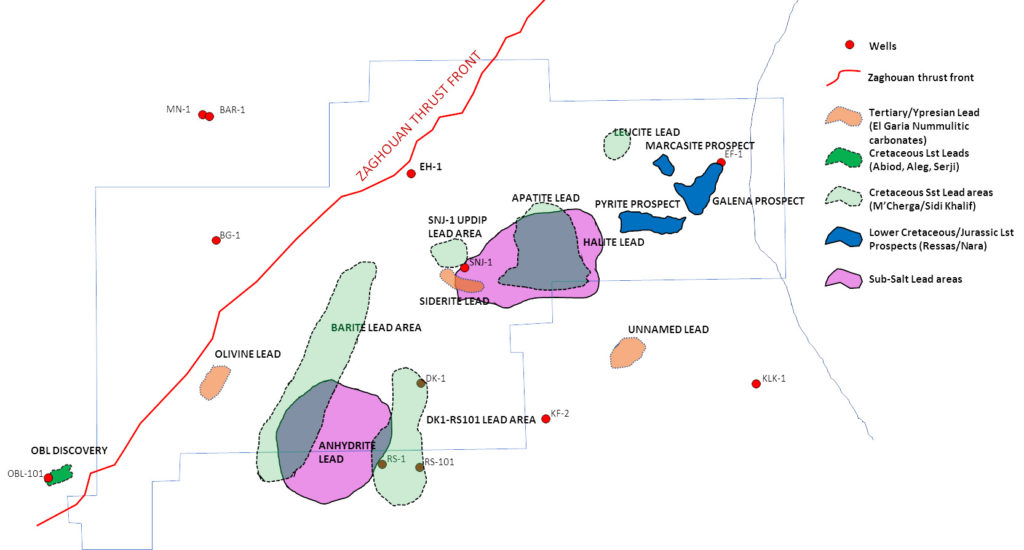
Volumetric estimation of each lead/prospect was performed, together with the estimation of potentially recoverable hydrocarbons (dry and wet gas), using a probabilistic method that provides the Low, Best and High estimate of these parameters.
More in detail, this work has resulted in the identification of a promising new play, identified in the eastern part of the Saouaf license, made of isolated carbonate platform bodies developed at Lower Cretaceous–Jurassic level. Several leads have been identified within this new play with the best-defined structure named ‘Pyrite’, a large structure interpreted to contain between 0.7 and 1.6 TCF of recoverable gas (respectively Low=P90 and High=P10 of Prospective Resources), with a most likely value of 1.1 TCF (Best=P50), equivalent to approx. 183 Million BOE.
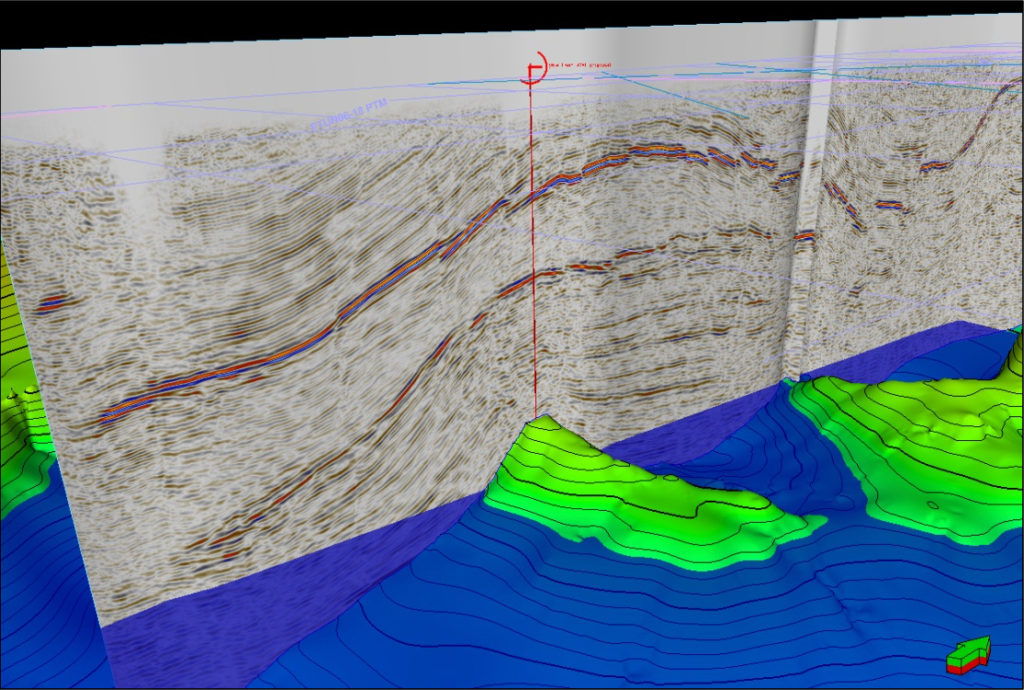
The Pyrite structure is defined by thirteen seismic lines of medium/good quality, most of which have been acquired in 2006 or in 2012 and subsequently reprocessed in 2013 by a previous operator. Pyrite is a large independent closure being part of a wide ring of carbonate build-ups of Early Cretaceous age (Ressas formation), which has been growing on top of a carbonate platform of Jurassic age (Nara formation). The top seal is represented by the shale-dominated Sidi Khalif and M’Cherga formations, which cap the carbonate build-ups.
Two other structures were also identified close to Pyrite, belonging to the same Jurassic-Lower Cretaceous carbonate play, named respectively Galena and Marcasite.
Saouaf Licence: the Pyrite structure
The technical work allowed also the identification of an additional promising sub-salt new play, which is new for the Saouaf area but is well proven in Algeria and Morocco, and is a key focus for work going forward. Comparisons were made with the giant gas field of Hassi R’Mel in Algeria (85 TCF of natural gas recoverable) and the recent gas discovery at Tendrara in North-Eastern Morocco (0.9 TCF recoverable + 8 TCF potential).
The sub-salt play is based on the presence within the Saouaf license area of an extensive Triassic salt formation likely acting as top seal and the presence of a light oil surface seep that suggest a mature, deep source rock active in the area, possibly the wide-spread and prolific Silurian “Hot Shale” formation.
The largest of the structural closures identified at Sub-Salt level, named ‘Halite’ lead, is also the best defined one on the basis of the seismic interpretation and a prominent gravity anomaly. Its potential is for multi-TCF of recoverable gas.
The upcoming work programme, which include reprocessing of existing seismic data, is aimed at sharpening the mapping of the Pyrite structure and at improving the imaging of the deep reflectors, testing at the same time for the presence of any indirect indication of gas saturated porosity below the Triassic salt formation.
Assessment of all leads identified within the license area continues with ongoing G&G work, including structural restoration, 1D/2D basin modelling and geochemical studies.